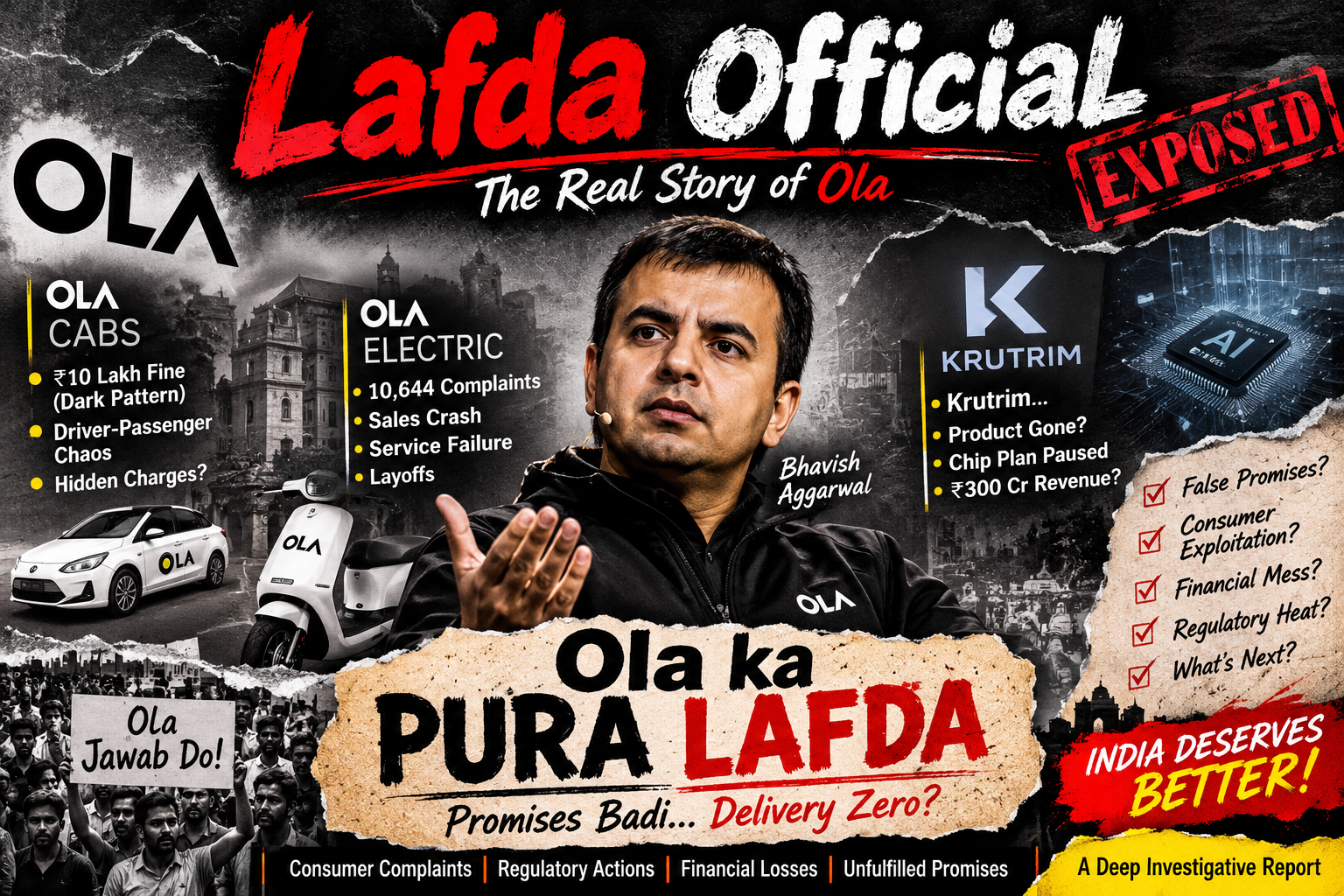
INSIDE THE EMPIRE OF PROMISES: CONSUMER COMPLAINTS, REGULATORY ACTIONS, FINANCIAL PRESSURE AND ABANDONED AMBITIONS
An investigative examination of Ola Cabs, Ola Electric, Krutrim AI and the business empire associated with Bhavish Aggarwal.
Research cut-off: 16 November 2026
THE CENTRAL QUESTION
Ola was built on a powerful promise: transform mobility in India, manufacture electric vehicles, build homegrown AI and create technology platforms capable of competing with global giants.
But what happens when the promises are compared with the documented record?
A consumer regulator found Ola Cabs' pre-ride payment prompts misleading and imposed a penalty.
Ola Electric faced thousands of consumer complaints and scrutiny over its service network.
SEBI issued a show-cause notice concerning certain company disclosures and sales-related announcements.
Ola Electric's revenue and deliveries have declined sharply.
The company's auditors issued a qualified review conclusion over a provision-related accounting matter.
Large workforce reductions have been reported.
Krutrim's consumer AI product and semiconductor ambitions were substantially scaled back.
These are not all the same kind of allegation. Some are regulatory findings, some are pending proceedings, some are reported events and some are financial disclosures.
But together, they raise a serious question:
Has Ola's ambition consistently moved faster than its execution and accountability?
This investigation examines the evidence.
PART I — OLA CABS: THE CUSTOMER EXPERIENCE
1. THE ₹10 LAKH DARK-PATTERN PENALTY
<badge color="danger">Official regulatory finding</badge>
On 13 November 2026, India's Central Consumer Protection Authority announced a ₹10 lakh penalty against ANI Technologies, which operates Ola Cabs.
The issue was the pre-ride tip/add-on feature.
The app asked passengers to pay additional money while it was still searching for a driver. Messages suggested that paying extra could improve the chances of getting a ride faster.
The feature was later renamed from "tip" to "add-on".
But the regulator found that the underlying practice remained unchanged.
What did the regulator discover?
Ola's own booking data for 1–15 June 2026 showed:
City | With add-on | Without add-on |
|---|---|---|
Delhi | 38% acceptance | 62% |
Bengaluru | 40% | 68% |
Mumbai | 39% | 68% |
In other words, the acceptance rates for rides carrying an add-on were lower than those without one.
The CCPA also found that:
Suggested amounts increased over time.
The app permitted additional payments of up to ₹499.
The methodology behind suggested amounts was not disclosed.
Consumers were not informed that the company's own data showed lower acceptance rates for add-on requests.
The interface used pre-set amounts and prompts that could pressure consumers.
The prompt appeared after the passenger had already booked the ride.
The CCPA ordered Ola to discontinue all pre-ride payment prompts and imposed a ₹10 lakh penalty.
Why this matters
A tip is ordinarily voluntary and given after a service has been provided.
Asking a passenger to pay extra before a driver has even accepted the booking raises a fundamental consumer-protection issue.
The regulator also noted that people travelling from hospitals, railway stations, bus terminals and airports could be particularly vulnerable to such prompts.
This is not merely a social-media complaint. It is an official regulatory finding.
Source:
https://www.pib.gov.in/PressReleaseIframePage.aspx?PRID=2335741&lang=2®=3
Official CCPA order:
https://www.ccpa.gov.in/checkuploaddocs.php?updocs=./uploads/f9862b3d98c685b4bff22c3016c50b859ae714fc64fdb786d248eb437ffc740.pdf
2. THE DRIVER-PASSENGER TRUST PROBLEM
Ride-hailing platforms operate between two groups: passengers and drivers.
Passengers expect a confirmed ride at the quoted price. Drivers expect a fair earning opportunity and transparent platform rules.
When drivers reject bookings, passengers face delays and cancellations. When passengers cancel, drivers may lose time and money.
The important questions for Ola are:
How are drivers compensated for cancellations?
How are driver incentives calculated?
What percentage of bookings are cancelled by drivers and passengers?
How are driver complaints resolved?
Can drivers independently understand deductions and payment calculations?
What safeguards prevent passengers from being pressured into paying more than the quoted fare?
These questions need verified platform data, driver interviews and actual payment statements. We should not turn individual complaints into claims about every driver or every passenger.
PART II — OLA ELECTRIC: THE CONSUMER CRISIS
3. 10,644 CONSUMER COMPLAINTS
<badge color="warning">Consumer watchdog scrutiny</badge>
In November 2024, the Indian Express reported that the National Consumer Helpline had received 10,644 complaints against Ola Electric between September 1, 2023 and August 31, 2024.
The reported complaints concerned product deficiencies and service-related grievances.
Ola Electric told the authorities that it had resolved 99.1% of the complaints.
But the follow-up raised further questions.
According to the report:
Officials attempted to contact 287 consumers.
They successfully spoke to 130.
Of those 130, 103, or 79.2%, said they were not satisfied with the company's response.
Important qualification: the 79.2% figure relates to the 130 consumers reached in that follow-up. It does not mean that 79.2% of all 10,644 complainants were dissatisfied.
Still, the gap between the company's reported resolution figure and the follow-up feedback deserved scrutiny.
The questions
What did Ola classify as "resolved"?
Did the customer confirm satisfaction?
How many complaints required repeat visits?
How many vehicles remained unrepaired after the first service visit?
What was the average time taken to resolve a warranty complaint?
Source:
https://indianexpress.com/article/india/ola-electric-consumer-watchdog-probe-9669427/
4. THE SERVICE-CENTRE AUDIT
In October 2024, Reuters reported that India's Ministry of Heavy Industries had ordered an audit of Ola Electric's service centres.
The Automotive Research Association of India was asked to examine service-centre maintenance and whether warranty obligations were being honoured.
The scrutiny followed consumer complaints about delayed or inadequate after-sales service and inaccurate invoices.
The report also described repair backlogs and concerns about overwhelmed service centres.
This matters because selling an electric scooter is only the beginning of the customer relationship.
A manufacturer must also provide:
Reliable repairs.
Spare-parts availability.
Warranty support.
Transparent invoices.
Timely customer communication.
The company's after-sales service is part of the product.
5. THE SALES-DISCLOSURE QUESTION: SEBI'S SHOW-CAUSE NOTICE
<badge color="warning">Pending regulatory matter — not a final finding</badge>
Ola Electric's FY2025–26 annual report disclosed that the company received a SEBI show-cause notice dated April 10, 2026.
The notice concerned certain disclosures relating to:
Expansion of the company's store and service-centre network.
Differences between vehicle sales figures in certain press announcements and delivery timelines.
Roadster motorcycle delivery-related disclosures.
The company's offer-document disclosures described additional allegations in the notice, including claims relating to:
Representing confirmed orders as sales in February 2025 disclosures.
Inaccurate statements about payment status.
Not disclosing order cancellations.
Inadequate or delayed disclosures about Roadster and Roadster X delivery timelines and prototype approval status.
These are allegations in a regulatory proceeding, not a final determination that the company committed wrongdoing.
What did Ola do?
The company disclosed that it had filed a settlement application with SEBI.
It explicitly stated that the application was made without admission or denial of the facts or legal conclusions and that the proceedings were ongoing.
Why this deserves attention
Investors and customers rely on accurate sales and operational disclosures.
A difference between bookings, confirmed orders, dispatches, registrations and actual deliveries can materially change the picture of a company's performance.
The key question is whether public statements accurately represented the underlying numbers.
The final outcome of the SEBI proceedings must be followed.
https://aibi.org.in/Current_DOC/q2627006.pdf
6. THE SALES COLLAPSE AND FINANCIAL PRESSURE
Ola Electric's latest Q2 FY2027 results, approved on November 12, 2026, show a difficult operating picture.
Q2 FY2027 consolidated results
Metric | Q2 FY27 | Q2 FY26 |
|---|---|---|
Revenue from operations | ₹421 crore | ₹690 crore |
Loss after tax | ₹362 crore | ₹418 crore |
Deliveries | 34,667 | 52,666 |
Revenue declined by approximately 39% year-on-year.
Deliveries declined by approximately 34%.
The quarterly loss improved compared with the previous year, which is a positive development. But the decline in revenue and deliveries remains a serious challenge.
First half of FY2027
Metric | H1 FY27 | H1 FY26 |
|---|---|---|
Revenue | ₹876 crore | ₹1,518 crore |
Loss after tax | ₹698 crore | ₹846 crore |
Operating cash flow | -₹403 crore | -₹343 crore |
The company continued to report operating cash outflow.
Management said it believed the group could continue as a going concern, taking into account available cash, future projections, credit limits and rights-issue proceeds.
The report also disclosed approximately ₹780 crore raised through a QIP during the first half and a subsequent rights issue of approximately ₹1,000 crore.
The central question
Can Ola Electric turn its manufacturing, service and distribution operations into a sustainable business without repeatedly relying on fresh capital?
Official investor relations:
https://www.olaelectric.com/investor-relations/financials
7. THE AUDITOR'S QUALIFIED REVIEW CONCLUSION
<badge color="warning">Accounting matter — not a fraud finding</badge>
The statutory auditor, B S R & Co. LLP, issued a qualified review conclusion on Ola Electric's consolidated Q2 and half-year FY2027 results.
The issue involved a provision for liquidated damages relating to a subsidiary, Ola Cell Technologies Private Limited, and an investment milestone under a Ministry of Heavy Industries incentive scheme.
The auditor's position was that:
A ₹57 crore provision recognised at March 31, 2026 should have remained in the June 2026 quarter.
An additional ₹11 crore provision should also have been recognised in that quarter.
The reversal should have occurred in the September 2026 quarter after the Ministry's conditional waiver letter.
The company had treated the matter differently.
This is an accounting recognition and timing disagreement. It is not proof of fraud.
Why investors should care
A qualified review conclusion deserves attention because it identifies a matter where the auditor disagrees with the company's accounting treatment.
Investors should understand the amount, the timing, the reasoning and the effect on reported financial results.
8. THE LAYOFF STORY
Ola Electric has undertaken multiple restructuring exercises.
Media reports described:
Around 500 employees affected in a November 2024 downsizing.
Around 1,000 employees and contract workers affected in March 2025.
A further planned reduction of approximately 5% of the workforce, around 620 roles, announced in January 2026.
Ola said its restructuring and automation efforts were intended to improve productivity and build a leaner organisation.
The company's explanation deserves to be included.
But repeated workforce reductions raise questions about business planning:
Were hiring plans too aggressive?
Were distribution and service operations expanded faster than demand justified?
Did automation replace roles that had only recently been created?
What happened to service quality after the reductions?
How were affected employees supported?
The company should explain the operational impact of these changes.
PART III — KRUTRIM: THE AI AMBITION
9. THE ₹1 BILLION AI UNICORN
Krutrim became India's first AI unicorn in January 2024 after raising $50 million at a reported $1 billion valuation.
Its ambitions included:
Developing Indian foundational AI models.
Building consumer AI products.
Developing semiconductor technology.
Creating AI cloud infrastructure.
Competing with global technology platforms.
The valuation was a major funding milestone.
But valuation does not independently prove technological leadership, product-market fit or customer adoption.
The questions are:
How much revenue came from independent customers?
How much came from Ola Group companies?
How many customers actively used its products?
What independent benchmarks validated its AI models?
How much of the original technology roadmap was completed?
10. KRUTI: THE CONSUMER AI PRODUCT WITHDRAWAL
Kruti was introduced as a consumer AI assistant.
It was intended to perform tasks beyond ordinary chatbot conversations, including integrations with services in Ola's ecosystem.
In April 2026, reporting said the Kruti assistant became unavailable across app stores and its web interface.
The company subsequently shifted its strategic focus towards cloud infrastructure.
This raises questions about:
Active users.
User retention.
Product development expenditure.
Product withdrawal decisions.
What happened to the underlying technology and roadmap.
The withdrawal does not prove that every Krutrim model or technology failed. It does mean that a high-profile consumer product did not continue in its original form.
11. THE SEMICONDUCTOR PROMISE
Krutrim also announced ambitions in semiconductor technology, including its Bodhi chip programme.
By 2026, reporting indicated that chip-design initiatives had been paused as the company redirected resources towards AI cloud services.
This is a substantial change from the original full-stack technology ambition.
The questions are straightforward:
What engineering milestones did Bodhi 1 achieve?
Was a working chip produced?
How much money was actually invested?
What happened to the semiconductor team?
What intellectual property and research remain?
A chip announcement is not the same as a commercially deployed semiconductor.
12. THE CLOUD PIVOT
Krutrim's 2026 strategy increasingly focused on AI cloud services.
TechCrunch reported approximately ₹300 crore in FY2026 revenue and the company's claim that it had achieved its first annual net profit.
It also reported that Krutrim said it had more than 25 enterprise customers.
These are positive developments and must be acknowledged.
But revenue composition matters.
How much came from external customers, and how much came from companies within the Ola Group?
A related-party sale may be legitimate revenue, but it does not establish the same degree of independent market demand as revenue from unrelated customers.
The question is not whether Krutrim can survive as a cloud business. The question is how much of the original AI ambition was actually delivered.
Official model documentation:
https://huggingface.co/krutrim-ai-labs/Krutrim-1-instruct
https://huggingface.co/krutrim-ai-labs/Krutrim-2-instruct
PART IV — THE COMMON THREAD
13. PROMISES VERSUS DOCUMENTED OUTCOMES
Area | Original ambition or expectation | Documented development |
|---|---|---|
Ola Cabs | Convenient, transparent rides | CCPA found pre-ride add-on prompts misleading |
Ola Electric | Mass-market electric mobility | Consumer complaints and service scrutiny |
Sales disclosures | Transparent growth reporting | SEBI show-cause notice; proceedings ongoing |
Manufacturing | Rapid EV expansion | Revenue and deliveries declined in Q2 FY27 |
Workforce | Large-scale growth | Multiple restructuring and layoff reports |
Financial stability | Sustainable EV business | Continued losses and operating cash outflow |
Krutrim AI | Full-stack Indian AI ecosystem | Consumer app withdrawal and chip programme pause reported |
AI cloud | Enterprise technology platform | Company reported revenue and enterprise customers |
This table does not establish that every business failed.
It shows that the original promises and the subsequent documented outcomes deserve to be examined together.
PART V — QUESTIONS FOR BHAVISH AGGARWAL AND OLA MANAGEMENT
Ola Cabs
Why did the company introduce a pre-ride tip/add-on prompt?
Why were consumers told that paying extra might improve ride confirmation?
Why did the company's own data show lower acceptance rates for add-on bookings?
What safeguards now prevent similar prompts from returning under another name?
What are the platform's driver cancellation, passenger cancellation and grievance-resolution statistics?
Ola Electric
What is the current status of the SEBI show-cause proceedings?
What is the company's definition of a resolved consumer complaint?
What was the average time to complete warranty repairs in FY2026?
How many vehicles required repeat service visits?
What is the current service-centre capacity and spare-parts availability?
Why did vehicle deliveries and revenue decline so sharply in Q2 FY2027?
What is the plan to reduce operating cash outflow?
What was the accounting basis for the disputed ₹57 crore and ₹11 crore provision?
What operational impact did the reported workforce reductions have?
Krutrim
How much of the original investment commitment was actually deployed?
How many active users did Kruti have before withdrawal?
What happened to its consumer AI technology?
What engineering stage did Bodhi 1 reach?
What percentage of FY2026 revenue came from external customers?
What remains of the original full-stack AI strategy?
Corporate governance
How are related-party transactions across the Ola ecosystem disclosed?
How are operational targets verified before public announcements?
What independent audits or benchmarks are available to validate major technology claims?
How does management measure customer satisfaction beyond complaint-closure statistics?
Will the company publish a clear progress report comparing original commitments with delivered outcomes?
FINAL VERDICT: ACCOUNTABILITY MUST MATCH AMBITION
Ola's story should not be reduced to a simplistic claim that everything it built failed.
Ola Electric has built and sold electric vehicles. Krutrim has developed AI models and reported a cloud business with revenue and customers. Ola Cabs continues to operate a major ride-hailing platform.
Those achievements matter.
But they do not erase the difficult questions.
The CCPA's finding against Ola Cabs is a concrete consumer-protection issue. Ola Electric's complaint history, service scrutiny and pending SEBI proceedings deserve continued examination. Its financial disclosures show substantial operating challenges. Krutrim's consumer AI and semiconductor ambitions changed significantly.
The larger issue is a recurring gap between public ambition and independently verifiable execution.
India does not need technology companies that merely announce the future. It needs companies that deliver reliable products, respect customers, treat employees fairly and disclose their performance honestly.
The Ola ecosystem has an opportunity to answer these questions with documents, data and transparency.
Until then, the public is entitled to keep asking.
THE REAL TEST OF A TECHNOLOGY EMPIRE IS NOT HOW BIG ITS PROMISES ARE. IT IS HOW WELL IT DELIVERS THEM.
SOURCE FILES AND PRIMARY DOCUMENTS
Ola Cabs
CCPA official order, November 10, 2026:
https://www.ccpa.gov.in/checkuploaddocs.php?updocs=./uploads/f9862b3d98c685b4bff22c3016c50b859ae714fc64fdb786d248eb437ffc740.pdfMinistry of Consumer Affairs / PIB press release, November 13, 2026:
https://www.pib.gov.in/PressReleaseIframePage.aspx?PRID=2335741&lang=2®=3
Ola Electric
3. Ola Electric Q2 FY2027 financial results:
https://cdn.olaelectric.com/sites/evdp/pages/investor/financials/fy27/q2/Ola_Electric_Mobility_Limited_Financial_Results_Q2_FY27.pdf
Ola Electric investor relations and financial disclosures:
https://www.olaelectric.com/investor-relations/financialsOla Electric FY2025–26 annual report:
https://nsearchives.nseindia.com/annual_reports/AR_31975_OLAELEC_2025_2026_A_20107852_08092026222027.pdfIndian Express — consumer complaints and CCPA scrutiny:
https://indianexpress.com/article/india/ola-electric-consumer-watchdog-probe-9669427/Reuters — service-centre audit:
https://www.reuters.com/world/india/india-orders-audit-olas-service-centres-after-consumer-complaints-source-2024-10-10/Reuters — January 2026 workforce restructuring:
https://www.reuters.com/business/world-at-work/indian-electric-scooter-firm-ola-electric-says-it-will-lay-off-5-workforce-2026-01-30/SEBI-related disclosures in Ola Electric's offer-document material:
https://aibi.org.in/Current_DOC/q2627006.pdf
Krutrim
10. TechCrunch — cloud pivot and AI ambitions:
https://techcrunch.com/2026/05/05/indias-first-genai-unicorn-shifts-to-cloud-services-as-ai-model-ambitions-face-reality/
Business Standard — FY2026 revenue and cloud pivot:
https://www.business-standard.com/companies/start-ups/krutrim-reports-first-profit-triples-revenue-as-it-pivots-to-ai-cloud-126050401703_1.htmlEntrackr — Kruti product withdrawal reporting:
https://entrackr.com/news/olas-krutrim-ai-assistant-kruti-inaccessible-across-web-and-app-stores-11731476Krutrim official model documentation:
https://huggingface.co/krutrim-ai-labs/Krutrim-1-instruct
https://huggingface.co/krutrim-ai-labs/Krutrim-2-instruct