
The Complete Story — From the Coaching Hostels of Kota to the Floor of Parliament: How India Built a System That Manufactures Degrees, Debt, Despair, and Rigged Results .And Calls It a Future
They don’t rob you at gunpoint.
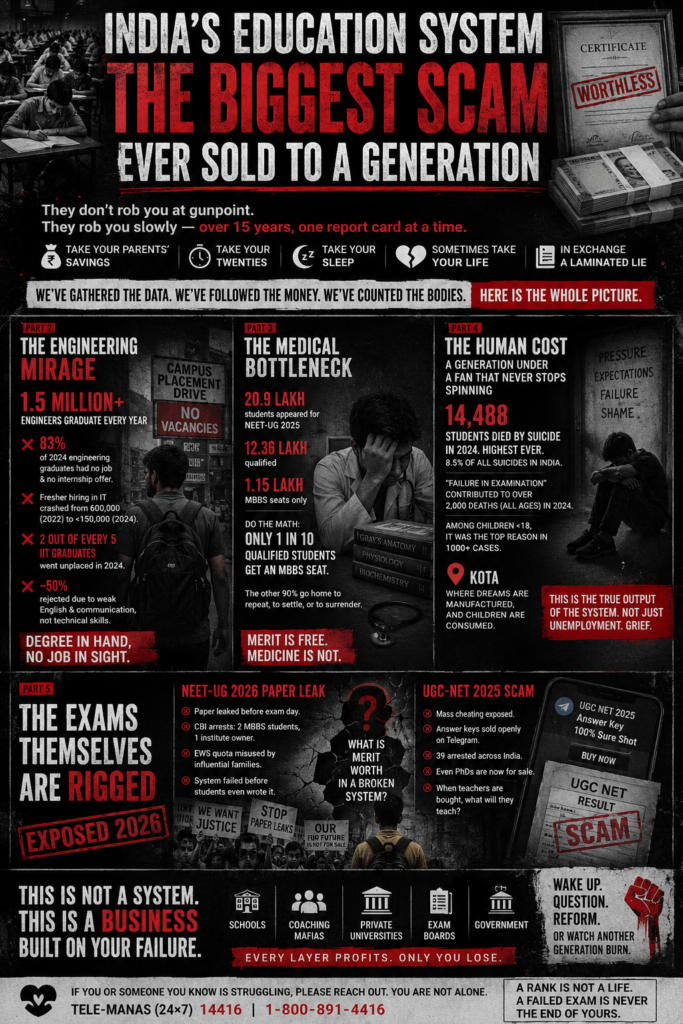
They rob you slowly — over 15 years, one report card at a time. They take your parents’ savings, your twenties, your sleep, and sometimes your life. In exchange they hand you a laminated certificate that the market decided was worthless before the ink was even dry.
This is not a story about a few bad colleges or one leaked paper. This is the story of an entire system — schools, coaching mafias, private universities, examination boards, and the government itself — quietly failing an entire generation, while every layer of it finds a way to make money from the failure.
We’ve gathered the data. We’ve followed the money. We’ve counted the bodies. Here is the whole picture, in one place.
PART 1 — THE PROMISE, AND THE LIE
Every Indian child grows up hearing the same prayer: padh lo beta, naukri lag jayegi. Study hard, the job will come.
It was true once. It is a lie now — and the numbers prove it.
According to the State of Working India 2026 report by Azim Premji University, roughly two-thirds (about 67%) of India’s unemployed aged 20–29 are graduates or postgraduates. In 2017 that figure was 46%. Translation: the more educated you are in this country, the more likely you are to be jobless.
The illiterate labourer finds something — a field, a cart, a stall. The graduate sits at home with a degree, a loan, and a “Open to work” banner on his profile. The same report found that fewer than half of all graduates are actually employed, and only about 6.7% hold a permanent salaried job.
The machine produces around 5 million graduates a year. The economy absorbs fewer than 3 million. The rest are surplus stock — manufactured to fail before they even collect their scrolls.
PART 2 — THE ENGINEERING MIRAGE
India pumps out over 1.5 million engineers a year — more than almost any nation on earth. We were told this was our superpower. Look what actually happens to them.
The Unstop Talent Report 2025 found roughly 83% of 2024’s engineering graduates had no job and no internship offer. An entire batch, manufactured for a market that never placed the order.
Colleges hide behind one magic word: employability. They love to claim 70%+ of engineers are “employable.” But employable on a test is not employed in a company — and the gap between those two words is where a million dreams die every year. Even the failure isn’t always technical: surveys repeatedly find roughly half of graduates rejected over weak spoken English and presentation, not weak coding.
Meanwhile the one industry that used to swallow these batches whole — IT services — slammed the door. Fresher hiring crashed from around 600,000 in 2022 to under 150,000 in 2024. Even the elite weren’t spared: reports suggest 2 out of every 5 IIT graduates went unplaced in 2024. If the IITian is struggling, what exactly is the boy from a Tier-3 private college paying ₹8 lakh for?
The privilege of joining the queue.
PART 3 — THE MEDICAL BOTTLENECK
Now take the hardest-working kids in the country: the NEET aspirants. The ones who don’t sleep for two years.
In 2025, around 20.9 lakh students appeared for NEET-UG. About 12.36 lakh qualified. The number of MBBS seats they were fighting over? Roughly 1.15 lakh.
Do the math on that cruelty: barely 1 in 10 qualified candidates actually gets an MBBS seat. The other 90% — kids who cleared one of the most brutal exams on the planet — go home to repeat, to settle, or to surrender.
And here’s the second blade. Government MBBS seats are now nearly matched by private and “deemed” university seats — where a single MBBS degree can cost a family a crore or more. The system doesn’t ban the poor from medicine. It simply prices the door, then tells the middle-class child: become a doctor on merit, or your father sells the house.
PART 4 — THE HUMAN COST: A GENERATION UNDER A FAN THAT NEVER STOPS SPINNING
This is the part the coaching brochures never show you.
The National Crime Records Bureau’s Accidental Deaths and Suicides in India 2024 report recorded 14,488 student deaths by suicide in a single year — the highest number ever documented, accounting for 8.5% of all suicides in the country and rising about 4.3% over the previous year.
Independent analysis has been even starker: a widely cited report titled “Student Suicides: An Epidemic Sweeping India” found that over two decades, student suicides grew at roughly 4% a year — double the national average. And “failure in examination” is named directly in the data: it contributed to over 2,000 deaths across all ages in 2024, and among children below 18, it was the single leading recorded cause in more than a thousand cases.
Behind every one of those numbers is a 16-to-21-year-old who was told their entire worth fit inside a rank. They are clustered most densely in Kota — the so-called “coaching capital” — where children are shipped from across the country, packed into hostels, and run through a pressure machine calibrated to produce toppers and discard everyone else. Year after year the headlines repeat, and year after year the machine keeps running, because despair, it turns out, is very profitable.
This is the true output of the system. Not just unemployment. Grief.
If you or someone you know is struggling, you are not alone and it is not weakness to ask for help. India’s national mental-health helpline Tele-MANAS is free and available 24×7 at 14416 (or 1-800-891-4416). A rank is not a life. A failed exam is never the end of yours.
PART 5 — THE EXAMS THEMSELVES ARE RIGGED
Here is the cruellest twist of all.
Children are studying themselves into the ground — some of them to death — for exams that the system itself cannot keep honest. In 2026, that stopped being a suspicion and became a documented fact, on two fronts at once.
The NEET paper that leaked before lakhs even sat for it
NEET-UG 2026 was conducted on 3 May 2026 for over twenty lakh aspirants. Within days, Rajasthan’s Special Operations Group reportedly recovered a document containing more than 300 questions, of which around 140 allegedly matched the actual paper. On 8 May, the National Testing Agency escalated the matter to central agencies; by 12 May 2026, the exam was cancelled outright, a CBI probe was ordered, and around 13 people were detained across Rajasthan and Uttarakhand.
Sit with what that means for the student. Two years of 18-hour days. The single most important morning of her life. And then a phone notification telling her it’s all void — re-exam soon — because somewhere, someone sold the paper. This is not the first time; 2024 saw a NEET paper-leak-and-grace-marks scandal that reached the Supreme Court, and 2025 saw partial retests. The pattern is now the policy.
The board that got caught by its own students
You might think: fine, the entrance exams are compromised, but at least the board marks are real. This year, three teenagers proved even that is a lie.
It began when 17-year-old Vedant Shrivastava simply questioned his own CBSE marks, applied for re-evaluation, found the numbers didn’t add up, and went public on X. Then 19-year-old Nisarga Adhikary reportedly found a security hole in CBSE’s own website that left student data exposed — the digital equivalent of the board leaving its filing cabinets unlocked on a public street. And then 17-year-old Sarthak Sidhant went after the money: he dug into the On-Screen Marking (OSM) tendering process — the system that decides which private firm gets paid to evaluate your answer sheets — and alleged that CBSE had effectively rewritten its own rules to favour a particular firm, Coempt EduTeck.
On 2 June 2026, this teenager stood before the Parliamentary Standing Committee on Education and laid his findings before the lawmakers of the nation. The Leader of the Opposition amplified his work. The board’s defence was that the contract simply went to “the lowest qualified bidder.” Its response to the breach? An announcement that experts from the government and the IITs would now “secure its systems” — an admission, by any honest reading, that they never were.
Three kids, with phones and public records, did in weeks what the entire education press corps failed to do in years.
And that is the unbearable arithmetic of this section: in one part of the country, children are dying over the fear of failing these exams — while in another, the exams are being leaked, the marks digitally mishandled, and the contracts allegedly rigged. They will gamble with the marks. So why would you ever trust them with the promise?
PART 6 — BBA, BCOM, AND THE WAGE THAT FORGOT HOW TO GROW
If engineering is the loud failure and medicine the cruel one, commerce is the silent one.
Millions enrol in BCom, BBA, and an ocean of nameless “management” courses, sold the fantasy of becoming managers and analysts. Most end up in a back-office seat, a sales target, or nothing. Even the MBA — the supposed golden ticket — is losing shine: skills reports show MBA “employability” sliding year on year, and surveys find close to half of B-school graduates sitting without a job or internship offer. Two out of three female arts and science graduates, one report noted, earn below ₹6 lakh a year.
And for the lucky few who do land a job, here’s the second trap. The average starting salary for an Indian graduate has been stuck at around ₹3–4 lakh a year for nearly a decade. Frozen. In that same decade, rent doubled, fees exploded, and a plate of dal became a luxury. So you have a generation earning 2015 salaries while paying 2026 prices — technically “employed,” and still going backwards every year. Mehengai eats the raise that never came.
This is why the sharpest kids in your colony are either coding for a foreign company at 3 a.m. or planning to leave the country entirely. They ran the numbers. The numbers say: get out.
PART 7 — THE GOVERNMENT-JOB STAMPEDE
When the private market collapses, every desperate Indian turns to the same last hope: the sarkari naukri. Security. A pension. Izzat.
So look at what that desperation produces in raw data. In 2023, Maharashtra opened 4,600 ‘talathi’ posts — a Class-C village revenue clerk job. Applicants? Over 10.5 lakh, including engineers, MBAs, and PhD holders fighting for a clerk’s chair. It is a national pattern: peon posts requiring only Class 5 have drawn applications from hundreds of doctorates and lakhs of graduates — so many that officials have cancelled exams, physically unable to process the crowd. Teacher-eligibility exams like CTET now pull over 25 lakh registrations in a single cycle.
A PhD applying to be a peon is not a funny news item. It is a death certificate for the promise this country made to its children.
And the final insult: the government has learned to profit from the queue. Every one of those lakhs of applicants pays a non-refundable application fee. Multiply a small fee by ten lakh desperate people and a single recruitment cycle quietly collects crores — hired or not. The exam itself has become a revenue stream. Your berozgari is on someone’s balance sheet.
PART 8 — FOLLOW THE MONEY: WHO ACTUALLY WINS
Strip away the speeches and the scam organises itself into a clean little ecosystem, each layer feeding on the same raw material — a hopeful young Indian:
- The coaching mafia sells fear. NEET, JEE, UPSC, SSC — a multi-thousand-crore industry built on convincing parents that one more course, one more test series, will save the child. It profits not from your success, but from your anxiety.
- The private colleges sell scarcity — lakhs in fees for degrees the market won’t honour, propped up by faked “placement records.”
- The examination machinery sells hope by the form, collecting fees from millions for posts that may never be filled and exams that may be cancelled.
- The MLM and “guru” grifters — the ones we’ve exposed before — wait at the exit, ready to sell “passive income” dreams to the graduate the system just spat out.
Every layer is fed by a young person who was told that effort plus education equals a future, and who is now standing in a queue ten lakh people long, holding a degree, paying a fee, hoping — if they made it that far at all.
THE BOTTOM LINE
This is not a story about lazy youth. This is the hardest-working generation India has ever produced. They cleared NEET. They wrote the 83% of engineering that the market threw away. They applied for the peon job and held the PhD. Some of them studied until it killed them.
The failure is not theirs. The failure is a system engineered to manufacture far more degrees than the economy can ever use, to monetise the gap at every single step, and — as 2026 laid bare — to leak the papers and rig the marks while doing it.
So before you spend the next ₹10 lakh and the next ten years, ask the one question the system never wants you to ask:
Am I buying an education — or just a more expensive way to stand in the same queue?
Vedant, Nisarga, and Sarthak asked their question. They shook Parliament with the answer.
Your turn.
Sources: NCRB — Accidental Deaths & Suicides in India 2024; “Student Suicides: An Epidemic Sweeping India” (IC3, 2024); State of Working India 2026 (Azim Premji University); India Skills Report 2025–26; Unstop Talent Report 2025; Medical Counselling Committee / NTA NEET-UG 2025 data; NTA notices and reporting on the NEET-UG 2026 cancellation and CBI probe; and reporting by The Statesman, Outlook, Business Today and The Wire on the 2026 CBSE OSM controversy. Figures are the latest available at the time of writing.
If this piece raised difficult feelings, India’s free 24×7 mental-health helpline Tele-MANAS can be reached at 14416.