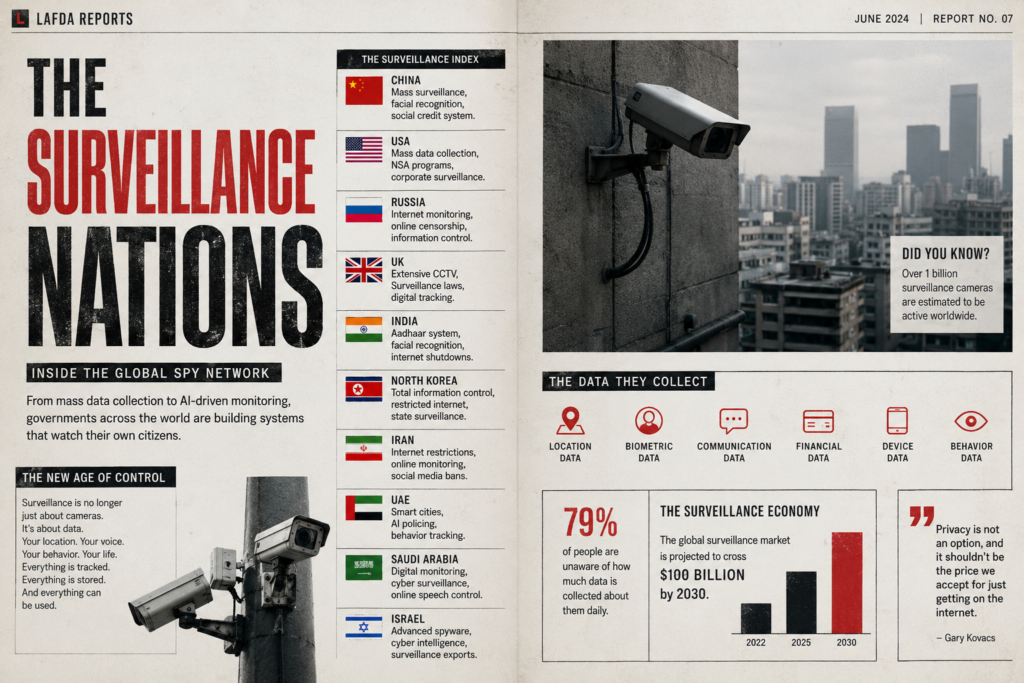

THE SURVEILLANCE NATIONS
How Governments Built The Largest Monitoring Systems In Human History
“The greatest shift in modern power may not be military.
It may be data.”
For decades, surveillance was treated as a background tool of governments.
Today, it has become infrastructure.
Across the world, states are rapidly expanding systems capable of monitoring:
- communication
- movement
- financial activity
- internet behavior
- biometric identity
- public spaces
The justification is almost always the same:
security.
But as digital infrastructure expands, privacy experts increasingly warn that modern surveillance systems may be evolving faster than the laws designed to regulate them.
This report examines the countries most frequently discussed in global surveillance debates — and how the modern monitoring economy quietly became one of the most powerful systems on Earth.
🇨🇳 China
THE BLUEPRINT OF DIGITAL CONTROL
No country is discussed more heavily in surveillance conversations than China.
Over the last decade, the country has built one of the world’s largest integrated surveillance ecosystems.
That infrastructure reportedly includes:
- massive CCTV networks
- AI-powered facial recognition
- digital identity integration
- internet filtering systems
- behavioral monitoring tools
Supporters argue the system improves:
- public safety
- urban efficiency
- crime prevention
Critics argue it represents the future of centralized digital control.
The scale itself is difficult to ignore.
Some estimates suggest hundreds of millions of surveillance cameras operate across the country, creating one of the densest monitoring environments in the modern world.
At the center of this system is artificial intelligence.
Modern surveillance is no longer passive recording.
It is increasingly predictive.
🇺🇸 United States
THE GLOBAL DATA SUPERPOWER
While China dominates discussions around physical surveillance infrastructure, the United States has long faced scrutiny regarding digital intelligence collection.
Public debate intensified after whistleblower disclosures revealed the scale of metadata and communications monitoring programs tied to intelligence operations.
The revelations shocked millions because they demonstrated a simple reality:
Modern governments could collect far more digital information than most citizens previously understood.
At the same time, American technology companies became the largest behavioral data collectors in history.
Platforms now track:
- search history
- viewing behavior
- emotional engagement
- purchasing habits
- location patterns
This created a system where both governments and corporations gained unprecedented visibility into human behavior.
The result is a new form of power:
predictive influence.
🇷🇺 Russia
CYBER POWER AND INFORMATION CONTROL
Russia’s surveillance discussions often revolve around:
- cyber operations
- internet regulation
- digital censorship
- state-controlled information systems
Over the years, authorities expanded legislation increasing control over online platforms and digital communication infrastructure.
At the same time, global cybersecurity analysts frequently connect Russian-linked cyber groups to sophisticated hacking operations and disinformation campaigns.
This reflects a broader trend:
surveillance is no longer only about cameras.
It is also about controlling information itself.
🇬🇧 United Kingdom
THE CCTV CAPITAL
The United Kingdom has frequently appeared in global privacy debates because of its extensive camera infrastructure.
In major urban centers, CCTV systems became deeply integrated into daily life:
- transportation hubs
- public streets
- commercial zones
- government facilities
Authorities argue the systems help:
- reduce crime
- improve investigations
- increase public safety
Critics question whether societies fully understand the long-term implications of permanent monitoring in public spaces.
The debate reflects a larger issue emerging globally:
When surveillance becomes normalized, citizens gradually stop noticing it altogether.
🇮🇳 India
THE RISE OF THE DIGITAL IDENTITY STATE
India’s rapid digital transformation has created one of the world’s largest identity-linked infrastructures.
Programs involving:
- biometric identification
- digital verification
- facial recognition pilots
- large-scale public databases
have triggered both praise and concern.
Supporters highlight:
- efficiency
- digital inclusion
- fraud reduction
Critics raise questions regarding:
- privacy safeguards
- data security
- centralized information systems
As India digitizes rapidly, the country increasingly finds itself at the center of future surveillance discussions.
🇰🇵 North Korea
THE CLOSED INFORMATION MODEL
North Korea represents one of the most extreme examples of centralized information control.
The country’s tightly restricted internet environment and state-controlled media structure create an ecosystem where digital freedom remains extremely limited.
Global analysts often describe the country as an example of what total information centralization can look like when external access is heavily restricted.
THE BUSINESS OF WATCHING HUMANS
Modern surveillance is no longer only political.
It is also economic.
The global surveillance technology industry is now worth billions.
Companies compete to develop:
- AI recognition software
- biometric systems
- predictive policing tools
- crowd analysis technology
- behavioral tracking algorithms
Governments buy the systems.
Corporations build them.
Citizens live inside them.
THE BIGGEST SHIFT: VOLUNTARY SURVEILLANCE
Perhaps the most important development is this:
People no longer need to be forced into surveillance systems.
They willingly participate.
Every day, billions voluntarily share:
- location data
- fingerprints
- facial scans
- voice recordings
- private conversations
- behavioral preferences
through apps, devices, and digital platforms.
Convenience accelerated adoption faster than regulation could react.
The result is a world where surveillance increasingly feels invisible.
And invisible systems are often the most powerful.
FINAL OBSERVATION
History shows that every powerful technology eventually raises the same question:
Who controls it?
Surveillance systems were originally designed to monitor threats.
But in the digital age, the definition of “threat” can expand rapidly.
The modern surveillance debate is no longer simply about privacy.
It is about power itself.
Because the ability to monitor populations at scale may become one of the defining forces of the 21st century.